originally posted by Grant Braswell of the Blumstein Team on Nearsay.com
This last weekend, Corcoran Sunshine (Corcoran’s new development arm) held a gigantic open house spanning the entire city and all of their new developments. Hundreds if not thousands of brokers and buyers came out in force to check out the properties. My team was onhand at a few locations mixing with both the looky-loos and serious buyers and investors. The weekend was deemed an all around success, the weather of course didn’t hurt one bit.
However, while new development’s high resale value and sometimes looser condo rules keep demand high and buyers interested, some areas, most notably the Villages, are wary of transformation. Blog posts and community discussions often espouse the eminent fall of the community values and feel due to new development.
For instance, there has recently been a lot of activity surrounding the potential development of 326-328 east 4th street, recently bought by Terrence Lowenberg a young and headstrong developer. The buildings in question, two 1830s homes have enormous potential for development as there are air rights to over 17,000 feet of buildable space – and the current design has it at just over 7,000 sqft combined. it was purchased for a little over $200 a buildable square foot, which, given maybe a $400-$500 dollar build out of new construction, would make the all in cost under $700 a foot. With condo prices in the area for new development around $1000+, this of course is a savvy business decision. However, community groups like the Greenwich Village Society for Historic Preservation and the East Village Community Coalition are pushing to have the buildings landmarked, which would effectively negate the developing power by handcuffing them with regulations regarding the facade and what new construction could be visible.
But who is right? There is no objective way to answer that, it is strictly a matter of opinion. As a resident of the area, I love the century old low-rise buildings, the details, the stoops, the little gates and low slung walls outside an English basement. You don’t have backyards and trees providing shade and grand greenery with most new development – just terraces and patios (but hey – any outdoor space is better than none).
Due to professional curiosty and the fact my team often works with investors, I went and saw the buildings while they were for sale. They were completely dilapidated – windows were broken, walls and floors were sagging and the backyard was littered with refuse once picked up perhaps with the notion of turning it into art. Instead, the place was crawling with stray cats and the backyard shed was unusable as the roof had caved in and trees and bamboo had grown up against it. The place, by all ‘normal’ standards of living was uninhabitable, and if it wasn’t for historic value it would be deemed a nuisance to the area.
So what is better? How can we as a community resolve the need for devlopment with the desire to maintain a sense of self?
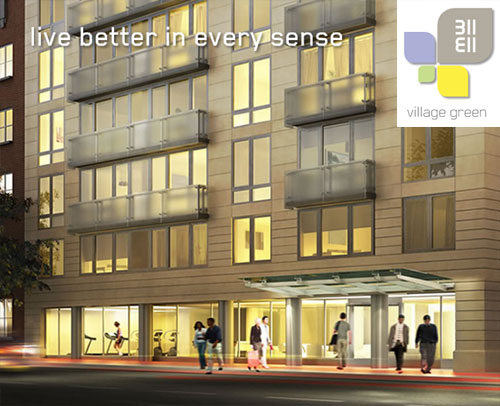
Over the weekend I was manning the Penthouse at 311 East 11th (aka Village Green) and standing on the south facing terrace pondering that exact issue. Of course we as brokers tend to like development – our clients do. But as a neighbor, I like the area for what it is and would be turned off by a Midtown feel in this residential haven.
Perhaps the answer lies in the craftsmanship of the development and its attempt to become part of the neighborhood, not stand out (though despite initially seeming wholly out of place in some ways, One Jackson in the West Village is a beautiful building whose natural looking curves gives its modern construction a sense of belonging…but I digress). For instance, Village Green attempts to vibe with the local culture, being the first LEED certified building out of Battery Park City. The common areas are heated and cooled geothermally, the floors of the units are 4″ Oak from a certified sustainable forest, and appliances were chosen for their high efficiency. It is well designed on the outside, and though it has a modern look, is not gaudy or ostentatious. The essence of the building was low-impact on the earth and neighborhood, given its modest profile of 8 floors. I am proud and excited for Village Green, both as a product of my company but also as a resident of the area who sees conscious development as a real possibility. It is proven, viable to build with quality and forethought in mind – despite healthy prices per square feet, within the first 5 months of being able to close the building is about 93% sold (one of the last two units should be in contract as of today, making it closer to 97%).
Eventually most buildings will need to be rebuilt, but they can be done without ruining the feel of the neighborhood, East Village or otherwise. Using quality (and preferably) sustainable materials, keeping profiles respectable within the construct of the neighborhood and nodding your cap to the aesthetic and personality of the area can do wonders for growth while maintaining a sense of history (if not in appearance, perhaps in sensibilities). It is not easy, but it can be done.
Click here for a list of many of Corcoran Sunshines’ new development listings downtown

 This Braswellian Life
Posted on October 25, 2010
0